

What is chest muscle tightness and what causes it?
Chest muscle tightness is a sensation of stiffness, pressure, or discomfort localized to the muscles of the chest wall, most often the pectoralis major and pectoralis minor. These two muscles run across the front of your chest and shoulder, and when they're overworked, shortened, or guarded, they produce that familiar feeling of tightness that can range from mildly annoying to genuinely alarming.
Most of the time, the cause is musculoskeletal. Muscle strain, poor posture, repetitive overhead motions, and even chronic stress can all tighten the pecs and surrounding chest wall muscles. Desk workers who spend hours hunched forward are especially prone, since that rounded-shoulder position keeps the pectoralis minor in a chronically shortened state. Athletes who overtrain pressing movements without balancing their upper back work run into the same problem.
That said, chest tightness can occasionally signal something more serious, including cardiac or pulmonary conditions. Proper diagnosis matters, and this article will help you understand the difference.
Common musculoskeletal causes at a glance:
- Muscle strain from heavy lifting, sports, or sudden exertion
- Poor posture (forward head, rounded shoulders) shortening the pecs
- Repetitive motions like rowing, throwing, or typing
- Anxiety-driven muscle guarding and shallow breathing
- Costochondritis, an inflammation of rib cartilage that mimics muscular pain
- Intercostal muscle strain from coughing or twisting
Pro Tip: If your chest tightness appeared gradually over days and worsens when you press on a specific spot or rotate your torso, the cause is almost certainly musculoskeletal. That reproducibility on touch is one of the clearest signs you're dealing with a muscle issue, not a heart issue.
Table of Contents
- How to recognize symptoms of muscular chest tightness
- What actually causes chest muscle tightness?
- Practical care and treatment strategies that actually work
- When chest tightness requires emergency medical attention
- How percussive therapy relieves tight chest muscles
- Diagnostic approaches to rule out serious conditions
- Exercises and stretches that relieve tight chest muscles
- Gilora makes percussive chest muscle relief accessible
- Key Takeaways
How to recognize symptoms of muscular chest tightness
Muscular chest tightness has a distinct symptom profile once you know what to look for. The discomfort tends to be achy rather than crushing, localized to one area rather than spreading across the chest, and it typically worsens with specific movements like twisting, reaching overhead, or taking a deep breath.
According to the Cleveland Clinic, one of the most reliable signs of musculoskeletal chest pain is that it can be reproduced by pressing on the chest wall or by performing certain movements. A cardiologist pressing on your sternum or ribs and recreating your exact pain is a strong indicator the problem is structural, not cardiac.
Symptoms typical of muscular tightness:
- Localized soreness or tenderness to the touch
- Pain that worsens with deep breathing, coughing, or twisting
- Stiffness that's worse in the morning or after sitting still
- Aching that improves with gentle movement or heat
- Tightness that follows a workout, heavy lifting, or a stressful week
Symptoms that are NOT typical of muscular tightness:
- Crushing pressure or heaviness in the center of the chest
- Pain radiating to the left arm, jaw, neck, or back
- Sudden nausea, cold sweats, or lightheadedness
- Shortness of breath at rest with no anxiety trigger
- Rapid or irregular heartbeat accompanying the chest sensation
Anxiety is worth a separate mention here. Stress and anxiety cause shallow breathing and chronic muscle guarding, which genuinely tightens the chest wall. The resulting sensation can feel physical and frightening, even when no structural damage is present. If your tightness comes with nervousness, a racing heart, and rapid breathing, anxiety may be the primary driver.
What actually causes chest muscle tightness?
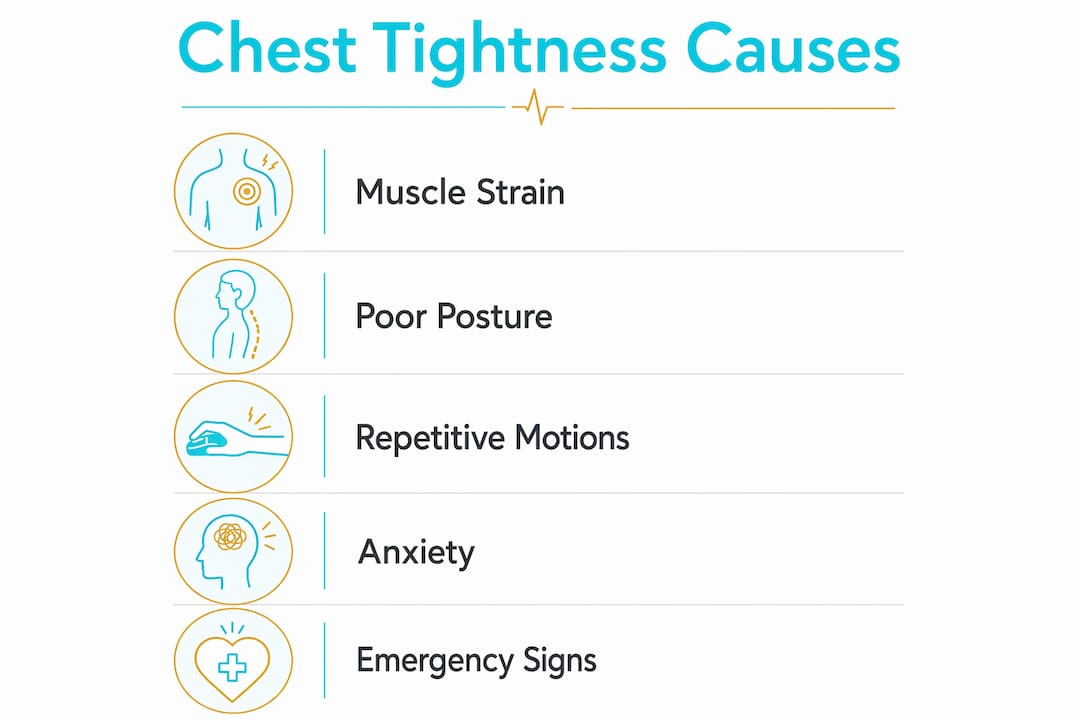
Chest muscle tightness is more often a lifestyle byproduct than an injury. Understanding the root cause is what separates a quick fix from lasting relief.
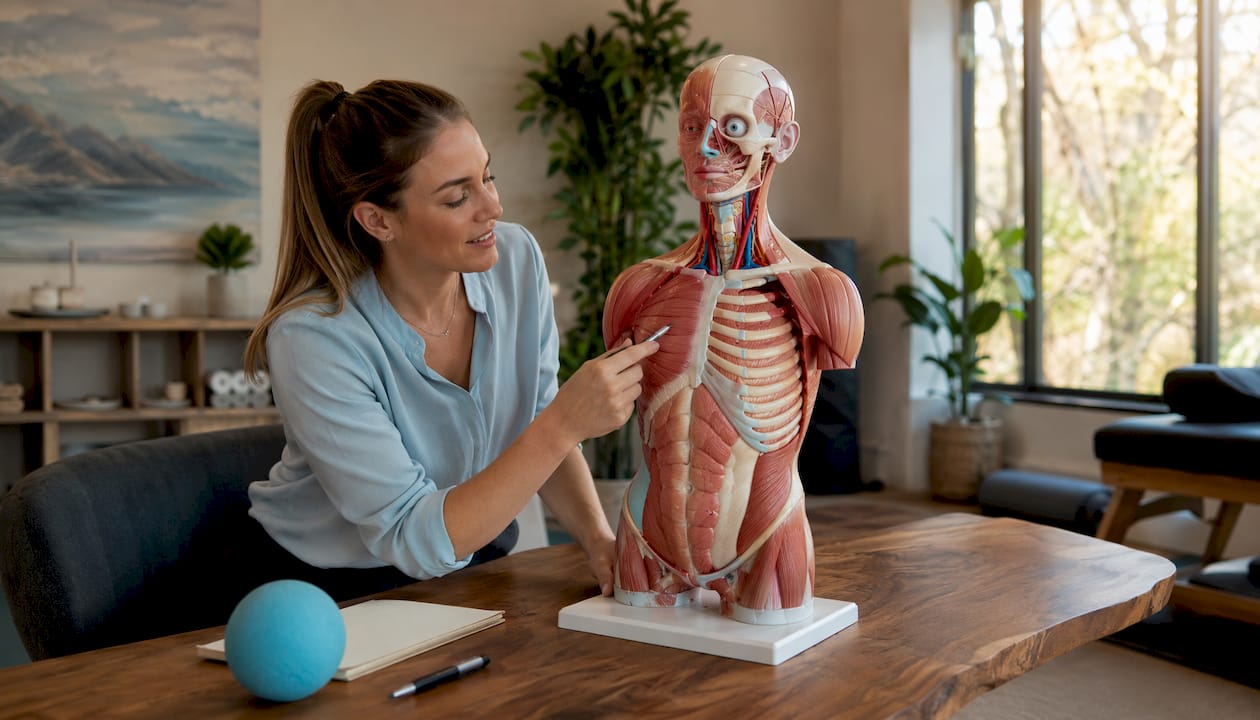
Musculoskeletal causes are the most common. Muscle strains of the chest wall, including the intercostal muscles between the ribs, cause pain that worsens with movement, deep breathing, or coughing. Sports, heavy lifting, and even prolonged coughing can strain these structures. Swelling or bruising sometimes accompanies a more significant strain.
Posture and ergonomics play a bigger role than most people realize. When you sit hunched at a desk for hours, your pectoralis minor adaptively shortens while your upper back muscles lengthen and weaken. Over time, this imbalance pulls the shoulders forward and keeps the chest in a compressed, guarded position. Physiotherapists consistently point to this chest-to-upper-back muscle imbalance as the underlying driver for a large share of desk-worker chest complaints.
Psychological factors are real contributors too. Chronic stress and anxiety trigger the body's fight-or-flight response, causing muscles throughout the chest and upper body to guard. Shallow chest breathing, which anxiety promotes, keeps the intercostal muscles and pecs in a state of low-level contraction. The result is genuine physical tightness, even without any structural injury.
Less common causes include:
- Costochondritis (rib cartilage inflammation)
- Viral infections affecting the chest wall (pleuritis)
- Fibromyalgia causing widespread muscle soreness
- Inflammatory conditions like rheumatoid arthritis affecting costal joints
Practical care and treatment strategies that actually work
The instinct to push through chest muscle tightness or aggressively massage it away is understandable, but counterproductive. Aggressive massage or stretching on an acute muscle strain worsens outcomes. The right approach depends on where you are in the recovery timeline.
In the first 48–72 hours after an acute strain:
- Rest and avoid the activity that caused the strain
- Apply ice for 15–20 minutes several times daily to reduce inflammation
- Use compression if the area allows it
- Over-the-counter options like ibuprofen or naproxen can reduce both pain and swelling
- Avoid aggressive stretching or deep massage during this window
After the acute phase passes, the approach shifts. Heat becomes more useful than ice, gentle mobility returns, and targeted stretching can begin. Physiotherapists recommend combining upper back strengthening with chest release techniques, since treating the pecs in isolation without addressing the weak upper back muscles that allowed the imbalance to develop rarely produces lasting results.
Ergonomic adjustments matter too. Raising your monitor to eye level, using a chair with proper lumbar support, and setting a reminder to stand and move every 45 minutes all reduce the postural load on the pecs throughout the day.
Pro Tip: Don't wait until the tightness becomes pain before addressing it. A five-minute chest-opening stretch and two minutes of upper back work at the end of each workday costs almost nothing and prevents the kind of chronic shortening that takes weeks to undo.
When chest tightness requires emergency medical attention
Some chest tightness is a medical emergency. Knowing the difference between a tight pec and a cardiac event is not optional knowledge.
Call 911 immediately if you experience any of the following:
- Chest pain or pressure lasting more than 10 minutes
- Pain radiating to the left arm, jaw, neck, or upper back
- Shortness of breath that is sudden or severe
- Nausea or vomiting alongside chest discomfort
- Cold sweats or sudden lightheadedness
- A feeling of impending doom or extreme fatigue
Harvard Health Publishing is direct on this: chest pain that spreads to the left arm or jaw, comes on gradually over several minutes, and is accompanied by sweating or nausea is far more likely to be a heart attack than a muscle issue. Chest pain that is sharp, localized to one spot, and reproducible by pressing on the chest is far less likely to be cardiac.
Pulmonary embolism is another serious cause. Sudden sharp chest pain combined with shortness of breath and a rapid heart rate, especially after a period of immobility like a long flight, warrants emergency evaluation.
The Mayo Clinic notes that chest pain from cardiac causes often feels like pressure, squeezing, heaviness, or tightness, not the localized soreness of a muscle strain. When in doubt, err on the side of getting checked.
Pro Tip: Trust your instincts. If something feels different from your usual muscle soreness, if the tightness appeared suddenly at rest, or if it's accompanied by any systemic symptoms, don't self-diagnose. Get evaluated. A false alarm is always better than a missed cardiac event.
How percussive therapy relieves tight chest muscles
Percussive therapy works by delivering rapid, targeted pulses of pressure into muscle tissue, improving local blood flow and reducing trigger-point sensitivity in the pectoralis major and minor. For chest muscle tightness specifically, percussion massage applied directly to the pec muscles helps release the chronic tension that stretching alone often can't fully address.
The key is technique and intensity. Starting at a low speed setting and working across the pec major in slow, overlapping passes is far more effective than pressing hard in one spot. Lying supine (on your back) while applying the device allows the chest muscles to fully relax, giving the percussion better access to the deeper pec minor.
How to use a percussion device on chest muscles effectively:
- Start at the lowest intensity setting and increase only if the muscle tolerates it
- Work in slow, 1-inch-per-second passes across the pec major from sternum to shoulder
- Spend 60–90 seconds per side, not more
- Follow immediately with an anterior shoulder stretch or doorway chest opener
- Combine with thoracic spine mobilization (foam roller on upper back) for full effect
For desk workers, daily short sessions at low intensity outperform occasional intense massage sessions. Consistency is what changes the tissue over time. A five-minute routine three to four times per week, combining percussion on the pecs with upper back mobility work, produces noticeably better results than a single aggressive session once a month.
Athletes benefit from percussive therapy post-training, particularly after heavy pressing days. Using a pec massage gun in the cool-down window, when muscles are still warm, helps prevent the next-day stiffness that accumulates into chronic tightness over a training cycle.
Pro Tip: Never use a percussion device directly on the sternum, ribs, or collarbone. Keep the device on the fleshy muscle belly of the pec, staying at least an inch away from bone. If you feel any sharp or radiating sensation during use, stop immediately.
Diagnostic approaches to rule out serious conditions
When chest tightness presents without an obvious musculoskeletal trigger, clinicians follow a structured diagnostic process to rule out cardiac, pulmonary, and other systemic causes before attributing symptoms to muscle.
A standard evaluation typically includes:
- Physical examination: The clinician presses on the chest wall, sternum, and rib cartilage to check for reproducible tenderness. Pain that exactly matches the patient's complaint when palpated strongly suggests a musculoskeletal origin.
- Electrocardiogram (ECG): Rules out arrhythmias and acute cardiac events. Usually the first test ordered in an emergency setting.
- Blood tests: Troponin levels indicate whether heart muscle has been damaged. Elevated troponin is a marker for heart attack.
- Chest X-ray: Identifies rib fractures, pneumonia, pneumothorax, or enlarged heart.
- Echocardiogram or stress test: Used when coronary artery disease or structural heart problems are suspected.
- CT pulmonary angiography: The standard test for suspected pulmonary embolism.
Once serious causes are excluded, the diagnosis of musculoskeletal chest pain is confirmed by the combination of reproducible tenderness, a relevant history (recent exertion, poor posture, stress), and the absence of systemic symptoms. At that point, treatment shifts entirely to the strategies covered in this article.
Exercises and stretches that relieve tight chest muscles
Stretching and strengthening work together. Releasing the pecs without strengthening the opposing upper back muscles is a short-term fix at best.
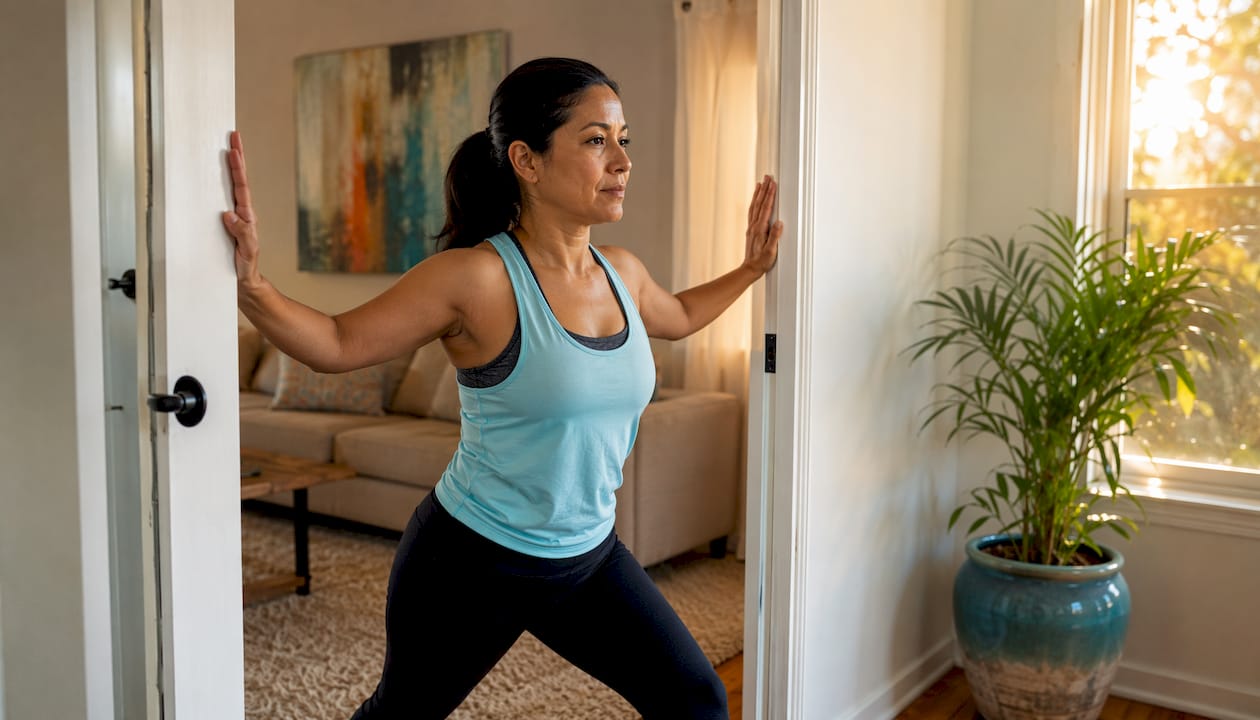
Doorway chest stretch
Stand in a doorway with both arms at 90 degrees, forearms resting on the door frame. Step one foot forward and gently lean into the doorway until you feel a stretch across the front of both shoulders and chest. Hold for 30 seconds, repeat three times. This is the single most accessible stretch for the pectoralis major and anterior shoulder.
Foam roller thoracic extension
Place a foam roller horizontally across your upper back, at about shoulder-blade height. Support your head with your hands, let your upper back extend over the roller, and hold for 30–60 seconds. Move the roller up and down the thoracic spine in small increments. This counteracts the forward rounding that keeps the chest compressed.
Band pull-apart
Hold a resistance band at shoulder height with arms extended, hands slightly wider than shoulder-width. Pull the band apart by squeezing your shoulder blades together, bringing your arms out to your sides until the band touches your chest. This directly strengthens the rhomboids and mid-traps, the muscles most responsible for keeping the chest open.
Pec minor stretch
Reach one arm behind you at roughly hip height, palm facing back, and gently rotate your torso away from that arm. You'll feel the stretch deep in the front of the shoulder and upper chest where the pec minor attaches. Hold 20–30 seconds per side.
Cat-cow breathing
On hands and knees, inhale as you drop your belly and lift your chest (cow), then exhale as you round your spine and tuck your chin (cat). Moving through this range with full diaphragmatic breathing retrains the breathing pattern that anxiety and poor posture disrupt, directly reducing the muscle guarding that contributes to chest tightness.
Perform these exercises daily for best results. Most people notice meaningful improvement in chest mobility within two weeks of consistent practice.
Gilora makes percussive chest muscle relief accessible
Percussive therapy is one of the most effective tools for managing tight chest muscles, but the device matters. A massage gun that's too loud, too aggressive, or too limited in speed options makes it harder to apply the low-intensity, controlled technique that chest muscles actually need.

The Gilora massage gun was built for exactly this kind of daily, targeted use. With 30 adjustable speed settings, you can start at the gentlest level for sensitive chest work and dial up only as the muscle loosens. Six interchangeable heads let you match the attachment to the muscle, using a flat head for broad pec coverage and a bullet head for more focused trigger-point work. At under 45dB, it runs quietly enough to use at your desk between meetings or in a gym without drawing attention.
Unlike high-end devices that charge two to three times the price for comparable performance, Gilora delivers professional-quality percussion at a fraction of the cost, backed by a 30-day money-back guarantee. If you're dealing with desk-related chest tension or post-workout pec tightness, it's a practical, affordable tool that fits into a daily routine without friction.
Key Takeaways
Chest muscle tightness is almost always musculoskeletal in origin, but the symptoms that distinguish it from a cardiac event are specific and worth knowing cold.
| Point | Details |
|---|---|
| Reproducibility is the key diagnostic sign | Muscular chest pain can be recreated by pressing on the chest wall; cardiac pain cannot. |
| Posture drives most chronic cases | Rounded shoulders and a weak upper back keep the pecs in a shortened, guarded state over time. |
| Acute strains need rest first | Aggressive massage or stretching in the first 48–72 hours worsens outcomes; use ice and rest instead. |
| Daily percussion beats occasional intense sessions | Consistent low-intensity percussive therapy combined with mobility work produces better sustained relief. |
| Gilora for targeted pec relief | The Gilora massage gun's 30 speeds and quiet operation make it well-suited for daily chest muscle recovery. |